
Your Health inOne Intelligent Platform
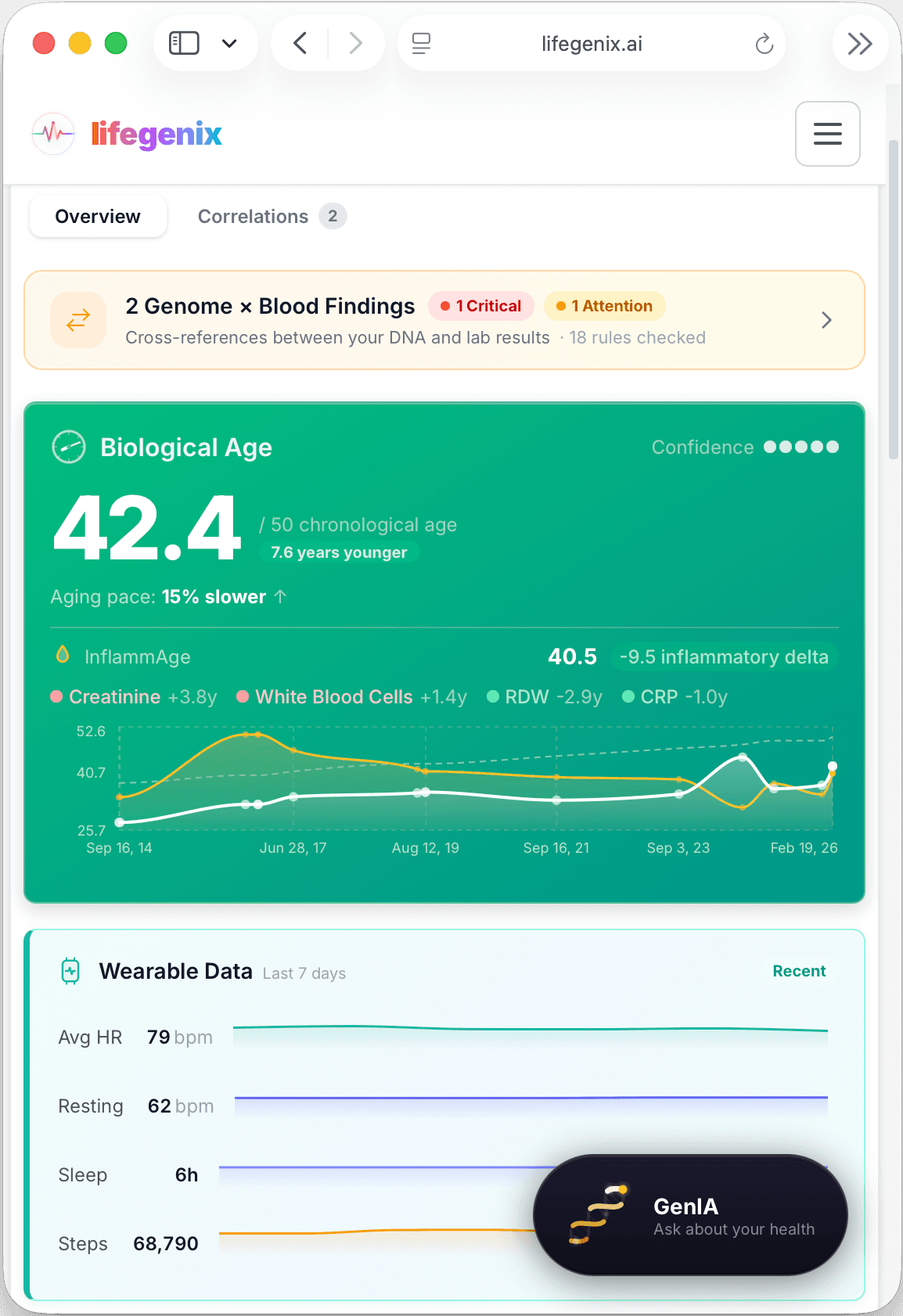
Blood tests, genetics, wearables, body composition — our AI cross-references everything to show you what's working, what isn't, and what you can change.
Genetics is immutable, but not implacable
You cannot change your DNA, but with the right information and the right actions, you can manage and respond to your genetic predispositions. Diet, exercise, and lifestyle choices can reshape the outcomes your genes predict.
Genetics: Your Starting Point
Immutable, but not a life sentence. Knowing your predispositions is the first step to managing them.
Your Tools: Knowledge + Action
Tailored nutrition, targeted exercise, informed supplementation — every choice moves the needle.
Results: Working With Your DNA
Normalized biomarkers, optimized health. You work with your biology, not against it.
Example: Genetic Predisposition for Type 2 Diabetes
Without Intervention
Variant TCF7L2 increases risk by 40%. A sedentary lifestyle + a diet high in simple carbs = the disease takes hold.
With lifegenix
Low-carb diet, exercise 5x/week, magnesium supplementation. Result: normalized blood glucose, risk reduced by up to 70%.
The difference? Actionable information + continuous monitoring. Your genetics warned you, but your choices saved you.
Based on published research (Tuomilehto et al., NEJM 2001; Diabetes Prevention Program, NEJM 2002). Individual results vary. This is not medical advice — consult your healthcare provider.
Your Data In. Insights Out.
Multiple AI models analyze your genetics, blood tests, and lifestyle together — not in isolation. The system finds cross-references between your DNA and your lab results, flags what matters, and shows you which changes in diet, exercise, or supplements could move the needle on your specific biomarkers. Each analysis gets smarter as the system learns from real-world correlations across all data types.
Under the Hood
Gets Smarter Over Time
Every analysis improves the system. The AI learns which genetic variants actually correlate with biomarker changes in real people — not just what the literature says.
- •Cross-validates findings across multiple AI models
- •Identifies patterns specific to your genetic profile
- •Updates interpretations as new research is published
Always Current
Our knowledge base is updated continuously from PubMed, ClinVar, and clinical guidelines — so your reports reflect the latest science, not last year's textbook.
- •New genetic studies integrated automatically
- •Reference ranges updated with latest clinical data
- •Drug-gene interactions tracked in real time
Everything in One Profile
Genetics, lab tests, bioimpedance, medications, diet, and lifestyle — all in one place, not scattered across apps
Actionable, Not Abstract
See exactly how changes in diet, exercise, or supplements could affect your actual health numbers
Privacy-First Architecture
Your health data is end-to-end encrypted and fully compliant with LGPD and HIPAA privacy standards
Chat with your Genetics
Unlike generic chatbots, GenIA has live access to your full genetic profile — over 500,000 markers through our genetic vault (GenomiX) — plus heart rate, sleep, steps, and other wearable metrics through our health data engine (VitaliX). It can pull any variant or health metric on demand.
Full Access to Your Data
The AI pulls specific markers on demand using GenomiX — enabling analyses that would be impossible if you had to paste hundreds of thousands of variants into a chat.
Pick Your AI Model
Choose which AI runs your analysis: Claude, Gemini, GPT-4, or others. Each model has different strengths for different types of questions.
Builds on Your History
GenIA has full context from every panel you've generated, so its answers build on your previous analyses — getting more precise each time.
Ask Anything, Get Specifics
Ask about specific variants, gene-gene interactions, or how certain polymorphisms affect your response to medications or nutrients.
Do I have risk for type 2 diabetes? What relevant SNPs do I have?
Let me fetch your diabetes-related markers...
Fetching: TCF7L2, PPARG, KCNJ11, SLC30A8...Integrated Health Data
A complete picture from every source of health data you have
Genetic Data
Your genetic blueprint — predispositions, ancestry, pharmacogenomics, and hereditary traits
Blood Tests
Lab results that show where you stand right now — and shift as your lifestyle changes
Bioimpedance
Detailed body composition — muscle mass, fat, water — all of which shift with diet and exercise
Physical Data
Body measurements and vital signs that track your current physical state
Epigenetic Data
How your environment and lifestyle modify your gene expression over time
Lifestyle
The daily habits that most influence your health — exercise, sleep, and stress management
Diet & Routine
Your eating patterns and daily routines — adjustable levers that directly impact your results
Medications
Current and past medications and supplements — they directly affect your lab results and how you feel
Medical History
Your medical history — symptoms, conditions, and the clinical context AI needs for accurate analysis
How It Works
Add Your Health Data
Start with whatever you have — blood tests, genetic files, wearable data, bioimpedance. You don't need all of them to get value.
We Build Your Profile
Your genetic variants are mapped, normalized, and cross-referenced with your lab results and lifestyle data into one unified health profile.
AI Finds Your Correlations
Multiple AI models look for connections between your DNA and your biomarkers — like how your TCF7L2 variant relates to your actual glucose levels.
You Get a Plan
Reports show which specific changes in diet, exercise, or supplements could improve your biomarkers — based on your actual genetics, not generic advice.
Got a DNA Test? Even Better.





Ready to See the Full Picture?
Bring together your genetics, lab tests, body composition, and lifestyle. Find out what you can change — and what difference it makes.
Add your health data and explore basic panels — no credit card required.